
Introduction
Mathematics is an essential part of everyday life. From calculating shopping bills and discounts to solving competitive exam questions and managing finances, math skills help us make quick and accurate decisions. However, many students and adults find lengthy calculations difficult and time-consuming.
This is where Vedic Maths Tricks can be extremely useful. Vedic Mathematics is a collection of simple calculation techniques and shortcuts that help solve arithmetic problems faster than traditional methods. These techniques are widely used by students, competitive exam aspirants, teachers, and professionals to improve speed and accuracy in calculations.
The popularity of Vedic Maths has increased significantly because it allows people to perform complex calculations mentally with less effort. Whether you’re preparing for bank exams, SSC, UPSC, CAT, engineering entrance tests, or simply want to sharpen your mental math skills, learning Vedic Maths tricks can be highly beneficial.
In this article, we’ll explore what Vedic Mathematics is, its history, benefits, popular tricks, multiplication shortcuts, division techniques, square calculations, and frequently asked questions.
What is Vedic Mathematics?
Vedic Mathematics is a system of mathematical techniques and shortcuts based on ancient Indian mathematical principles. It is known for simplifying arithmetic operations through logical patterns and mental calculation methods.
The system consists of several formulas and sub-formulas, commonly known as:
- Sutras
- Sub-Sutras
These formulas provide alternative methods for solving mathematical problems quickly.
Vedic Maths focuses on:
- Mental calculations
- Speed
- Accuracy
- Logical thinking
- Simplified problem-solving
History of Vedic Mathematics
Vedic Mathematics gained popularity through the work of Jagadguru Swami Bharati Krishna Tirthaji, who compiled mathematical techniques from ancient Indian texts and presented them in a structured format.
His work introduced several mathematical formulas that could simplify calculations involving:
- Addition
- Subtraction
- Multiplication
- Division
- Squares
- Cubes
- Algebra
- Geometry
Today, Vedic Mathematics is taught in schools, coaching institutes, and skill-development programs around the world.
Benefits of Learning Vedic Maths Tricks
Faster Calculations
Vedic methods often reduce the number of calculation steps.
Improved Mental Ability
Regular practice strengthens mental arithmetic skills.
Better Exam Performance
Helpful in competitive exams where speed matters.
Increased Confidence
Students become more comfortable with numbers.
Reduced Dependency on Calculators
Many calculations can be performed mentally.
Enhanced Logical Thinking
Encourages pattern recognition and analytical skills.
Why Students Use Vedic Maths
Students often use Vedic Maths because:
- It saves time during exams.
- It improves calculation speed.
- It reduces mathematical anxiety.
- It enhances concentration.
- It builds confidence in arithmetic.
These advantages make Vedic Maths particularly useful for school students and competitive exam aspirants.
Also Read : Top 25 Vedic Maths Tricks with Examples
Popular Vedic Maths Tricks
Let’s explore some commonly used Vedic Maths techniques.
Trick 1: Multiplication by 11
Multiplying a two-digit number by 11 becomes very easy using Vedic Maths.
Example
23 × 11
Step 1:
Write first digit = 2
Step 2:
Add digits:
2 + 3 = 5
Step 3:
Write last digit = 3
Result:
253
Therefore:
23 × 11 = 253
Another Example
54 × 11
5 + 4 = 9
Result:
594
Thus:
54 × 11 = 594
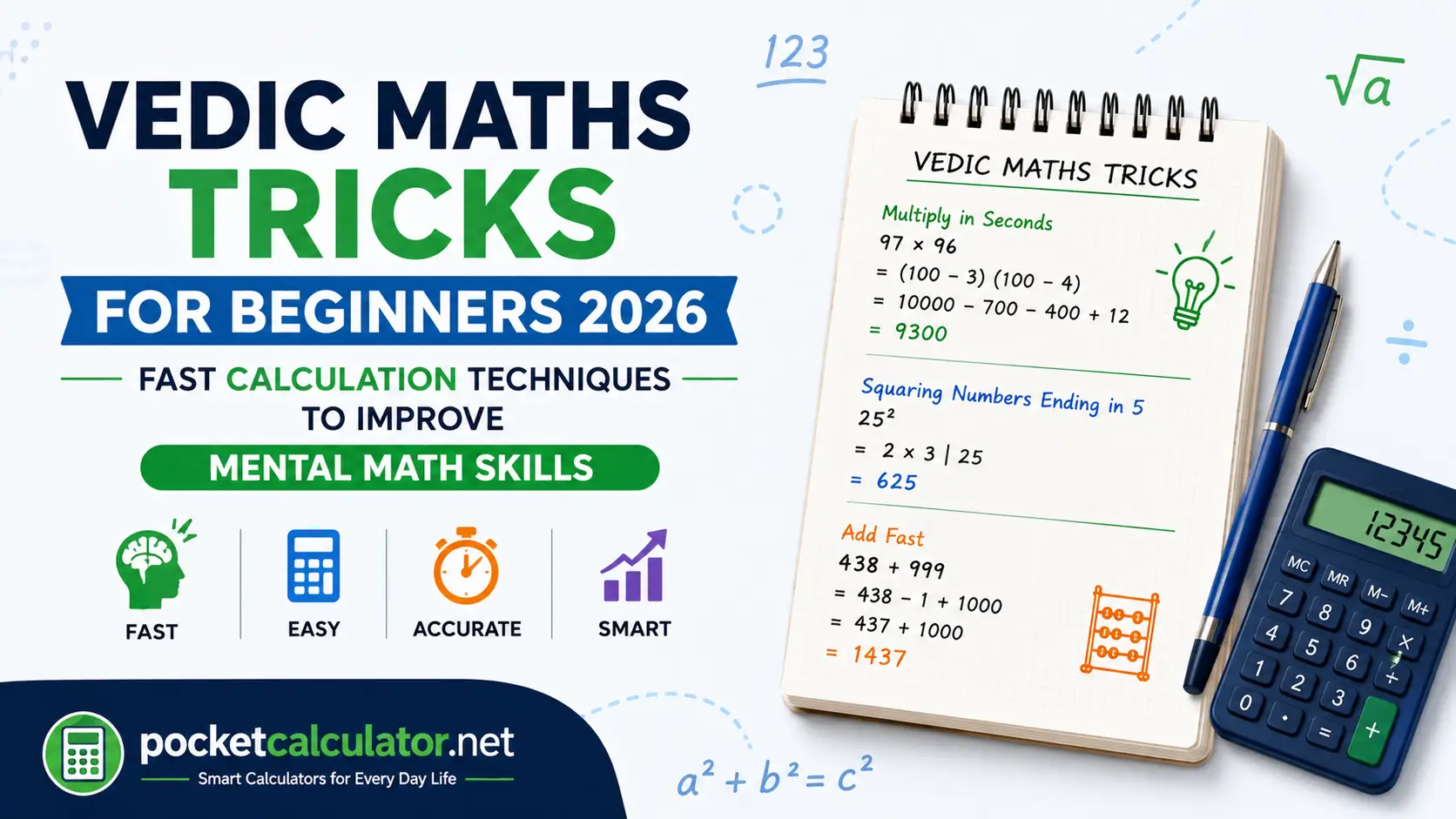
Trick 2: Squaring Numbers Ending in 5
This is one of the most famous Vedic Maths tricks.
Formula
If a number ends in 5:
Multiply the first digit(s) by the next higher number and append 25.
Example
25²
2 × 3 = 6
Append 25
Result:
625
Example
35²
3 × 4 = 12
Append 25
Result:
1225
Example
75²
7 × 8 = 56
Append 25
Result:
5625
Trick 3: Multiplication Near 100
This technique works when numbers are close to 100.
Example
97 × 96
Difference from 100:
97 = -3
96 = -4
Subtract diagonally:
97 – 4 = 93
Multiply differences:
3 × 4 = 12
Result:
9312
Therefore:
97 × 96 = 9312
Trick 4: Quick Percentage Calculation
To find 10% of a number:
Move the decimal point one place left.
Example
10% of 450
= 45
To find 5%:
Calculate 10% and divide by 2.
Example
5% of 450
10% = 45
45 ÷ 2 = 22.5
Answer:
22.5
Trick 5: Multiplication by 5
Multiply by 5 using a simple method.
Formula
Divide by 2 and multiply by 10.
Example
48 × 5
48 ÷ 2 = 24
24 × 10 = 240
Answer:
240
Trick 6: Multiplying Two-Digit Numbers with Same First Digit
Example
43 × 47
First digit = 4
Last digits:
3 + 7 = 10
Multiply first digit by next higher number:
4 × 5 = 20
Multiply last digits:
3 × 7 = 21
Answer:
2021
Trick 7: Quick Square of Numbers Close to 50
Example
52²
Difference from 50 = 2
Formula:
50² + (50 × 2 × Difference) + Difference²
2500 + 200 + 4
= 2704
Thus:
52² = 2704
Trick 8: Multiplication Using Vertically and Crosswise Method
One of the most famous Vedic Maths methods.
Example
12 × 13
Step 1:
1 × 1 = 1
Step 2:
Cross multiplication:
(1 × 3) + (2 × 1)
= 5
Step 3:
2 × 3 = 6
Answer:
156
Trick 9: Divisibility Test for 9
A number is divisible by 9 if the sum of its digits is divisible by 9.
Example
729
7 + 2 + 9
= 18
1 + 8 = 9
Therefore:
729 is divisible by 9.
Trick 10: Quick Multiplication by 9
Example
56 × 9
Formula:
56 × (10 – 1)
= 560 – 56
= 504
Answer:
504
Vedic Maths Tricks for Competitive Exams
Competitive examinations often require quick calculations.
Popular exams where Vedic Maths helps include:
- SSC
- Banking Exams
- CAT
- UPSC Aptitude Tests
- Railway Exams
- Defence Exams
- Insurance Exams
These exams frequently contain arithmetic and quantitative aptitude questions where speed is important.
Vedic Maths for School Students
School students benefit because:
- Calculations become easier.
- Interest in mathematics increases.
- Confidence improves.
- Homework takes less time.
- Mental arithmetic becomes stronger.
Many educational institutions now incorporate Vedic Maths training into learning programs.
Vedic Maths vs Traditional Mathematics
| Feature | Vedic Maths | Traditional Maths |
|---|---|---|
| Speed | Faster | Moderate |
| Mental Calculation | Strong Focus | Limited |
| Calculation Steps | Fewer | More |
| Exam Efficiency | High | Moderate |
| Pattern Recognition | Strong | Moderate |
Both systems are valuable and often complement each other.
Tips to Learn Vedic Maths Quickly
Practice Daily
Regular practice improves speed.
Start with Basic Tricks
Learn multiplication and square shortcuts first.
Focus on Accuracy
Speed should not come at the cost of correctness.
Solve Real Problems
Apply tricks to practical calculations.
Use Mental Calculation
Avoid calculators during practice sessions.
Common Misconceptions About Vedic Maths
It Replaces Traditional Mathematics
False.
Vedic Maths complements traditional methods but does not replace them.
Only Geniuses Can Learn It
False.
Anyone can learn Vedic Maths through practice.
It Works Only for Small Numbers
False.
Many techniques work for large numbers as well.
It Is Only for Students
False.
Professionals, teachers, and business owners also use Vedic Maths.
Frequently Asked Questions (FAQs)
What is Vedic Maths?
Vedic Maths is a collection of mathematical shortcuts and calculation techniques designed to simplify arithmetic operations.
Is Vedic Maths useful for competitive exams?
Yes. It helps improve calculation speed and accuracy, which can be beneficial in aptitude-based exams.
Can beginners learn Vedic Maths?
Absolutely. Most tricks are simple and easy to understand.
Does Vedic Maths improve mental math skills?
Yes. Regular practice strengthens mental calculation abilities.
Is Vedic Maths difficult?
No. Many techniques are easier than traditional methods once understood.
Can adults learn Vedic Maths?
Yes. Vedic Maths is suitable for learners of all ages.
Does Vedic Maths require memorization?
Some formulas and patterns need practice, but most methods are based on logical relationships.