
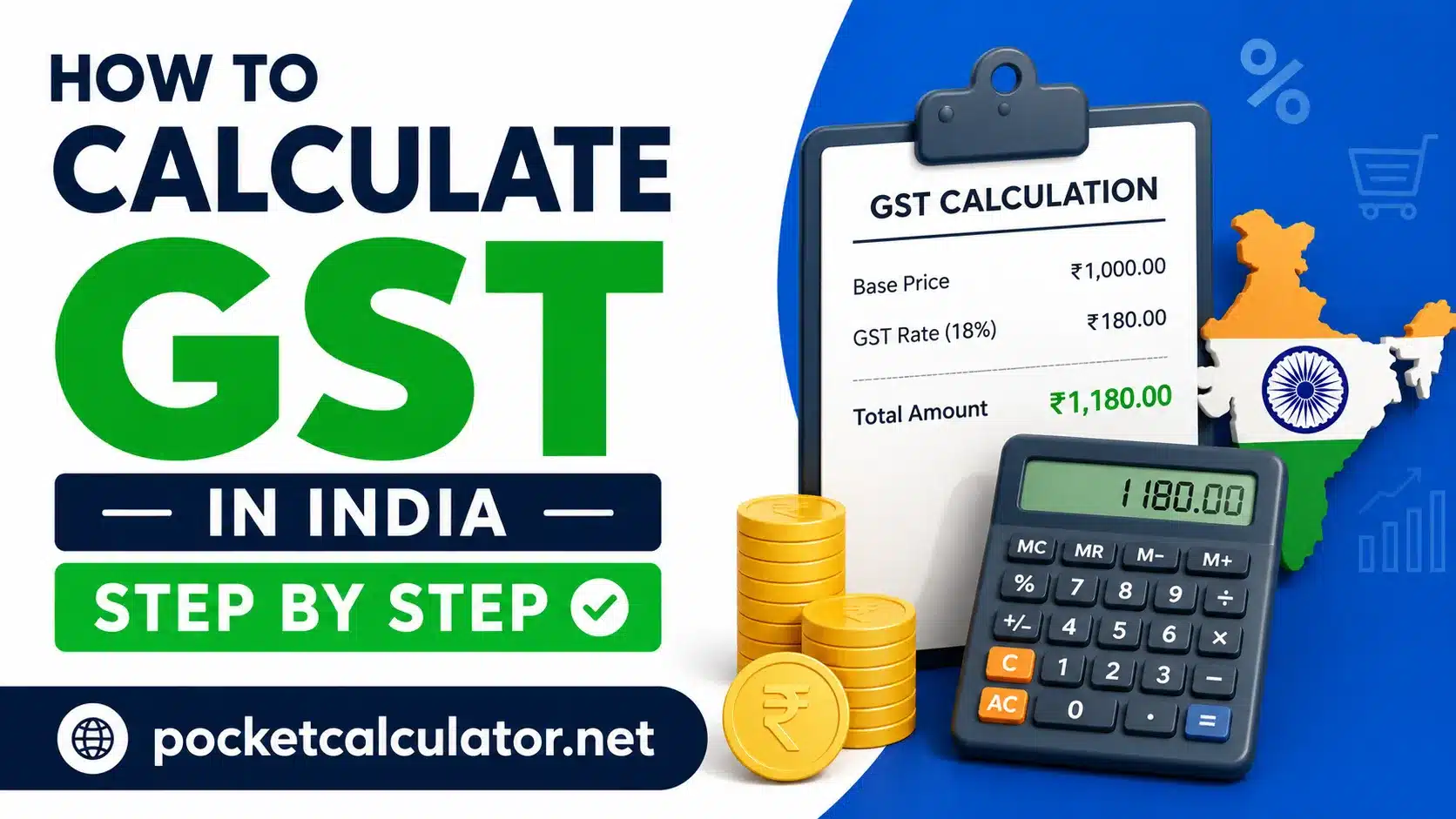
🧾 How to Calculate GST in India Step by Step (Beginner’s Guide)
If you’ve ever checked a bill in India—whether at a restaurant, electronics store, or online—you’ve definitely seen GST added to the price.
But many people still wonder:
👉 How exactly is GST calculated?
👉 What’s the difference between CGST, SGST, and IGST?
👉 Am I paying the correct amount?
The good news? GST is actually very simple once you understand the logic.
In this guide, I’ll walk you through step-by-step GST calculation, with easy examples, real-life situations, and practical tips so you can confidently calculate GST anytime.
💡 What is GST (In Simple Words)?
GST (Goods and Services Tax) is a single tax applied to goods and services across India.
👉 It replaced multiple older taxes like VAT, service tax, excise duty, etc.
🧠 Why GST was introduced:
- To simplify the tax system
- To avoid “tax on tax”
- To make pricing more transparent
Types of GST in India
Before calculating GST, you need to understand how it is applied.
1️⃣ CGST (Central GST)
Collected by the central government
2️⃣ SGST (State GST)
Collected by the state government
3️⃣ IGST (Integrated GST)
Applied when goods/services move between states
🧾 Quick Rule:
| Transaction Type | GST Applied |
|---|---|
| Within same state | CGST + SGST |
| Between states | IGST |
🧮 Step-by-Step GST Calculation (Exclusive Price)
Let’s start with the most common case—GST is added to the price.
✅ Step 1: Identify Original Price
Example: ₹1,000
✅ Step 2: Identify GST Rate
Example: 18%
✅ Step 3: Calculate GST Amount
👉 GST = (Price × Rate) ÷ 100
GST = (1000 × 18) ÷ 100 = ₹180
✅ Step 4: Calculate Final Price
👉 Final Price = Price + GST
Final Price = ₹1,000 + ₹180 = ₹1,180
🧾 Step 5: Split GST (If Within State)
- CGST = 9% → ₹90
- SGST = 9% → ₹90
📊 Quick Example Table
| Price | GST Rate | GST Amount | Final Price |
|---|---|---|---|
| ₹500 | 5% | ₹25 | ₹525 |
| ₹1,000 | 12% | ₹120 | ₹1,120 |
| ₹2,000 | 18% | ₹360 | ₹2,360 |
| ₹5,000 | 28% | ₹1,400 | ₹6,400 |
🔍 Step-by-Step GST Calculation (Inclusive Price)
Sometimes GST is already included in the price.
Example:
👉 You see a product priced at ₹1,180 (inclusive of 18% GST)
Now the question is:
👉 How much GST is included?
✅ Step 1: Use Formula
👉 GST = (Final Price × Rate) ÷ (100 + Rate)
✅ Step 2: Apply Values
GST = (1180 × 18) ÷ 118 = ₹180
✅ Step 3: Find Original Price
Original Price = ₹1,180 – ₹180 = ₹1,000
🧠 GST Rate Slabs in India
Different products fall under different tax rates:
| GST Rate | Category |
|---|---|
| 0% | Essentials (grains, fresh food) |
| 5% | Daily-use items |
| 12% | Processed goods |
| 18% | Most products/services |
| 28% | Luxury items |
👉 Most common rate = 18%
🧡 Real-Life Example (Easy to Relate)
Let’s say you buy a mobile phone.
- Price = ₹15,000
- GST rate = 18%
Calculation:
GST = ₹2,700
Final price = ₹17,700
Now imagine you’re buying with a tight budget.
👉 That extra ₹2,700 matters!
This is why understanding GST helps you make better decisions.
🍽️ Another Real-Life Scenario
You go to a restaurant with friends.
- Food bill = ₹2,000
- GST = 5%
GST = ₹100
Final bill = ₹2,100
Split among 3 friends:
👉 ₹700 each
Now you know exactly how the bill was calculated.
Also Read : How to Use Scientific Calculator Properly 2026
🔧 Common GST Calculation Mistakes
❌ Mistake 1: Ignoring Inclusive Price
Always check if GST is already included.
❌ Mistake 2: Using Wrong GST Rate
Different items have different tax rates.
❌ Mistake 3: Not Checking Invoice
Sometimes incorrect GST is charged.
🧭 Practical Tips for Accurate GST Calculation
- ✔️ Always ask: “Inclusive or exclusive?”
- ✔️ Remember common rates (5%, 12%, 18%)
- ✔️ Use calculator for quick results
- ✔️ Verify bills before paying
🧾 GST for Business Owners (Quick Insight)
If you run a business, GST works differently.
You:
- Collect GST from customers
- Pay GST to government
But here’s the benefit:
👉 Input Tax Credit (ITC)
Example:
- You paid ₹100 GST on raw materials
- Collected ₹180 from customers
👉 You only pay ₹80 to government
🧡 Real-Life Business Story
Amit runs a small electronics shop.
- Buys goods for ₹10,000 + GST
- Sells for ₹15,000 + GST
He collects GST from customers—but doesn’t pay double tax.
👉 Thanks to ITC, he only pays the difference.
This is how GST simplifies business taxation.
⚖️ Why Understanding GST Matters
Knowing GST helps you:
- ✔️ Avoid overpaying
- ✔️ Understand bills clearly
- ✔️ Make smarter purchases
- ✔️ Run business efficiently
📱 Should You Use GST Calculators?
Yes 👍
They are:
- Fast
- Accurate
- Easy to use
But if you know the manual method (like now), you’re always in control.
Frequently Asked Questions (FAQs) ❓
What is the easiest way to calculate GST?
👉 GST = (Price × Rate) ÷ 100
How do I calculate GST from inclusive price?
👉 GST = (Final Price × Rate) ÷ (100 + Rate)
What is 18% GST on ₹1,000?
GST = ₹180
Final price = ₹1,180
What is CGST and SGST?
CGST → Central government
SGST → State government
What is IGST?
Applied on interstate transactions (between states)
Can GST rate change?
Yes. Government updates rates from time to time.
🎯 Final Thoughts
GST may seem technical at first—but once you break it into steps, it becomes very logical.
The key idea is simple:
👉 GST is just a percentage added to (or included in) the price
When you understand:
- How to calculate it
- How to identify it
- How it applies
You become more confident—not just as a buyer, but also as a business owner.
One Line to Remember
“If you know the price and the rate, GST becomes easy.”
Calculate GST Online | Calculate GST Step | Calculate GST Guide